
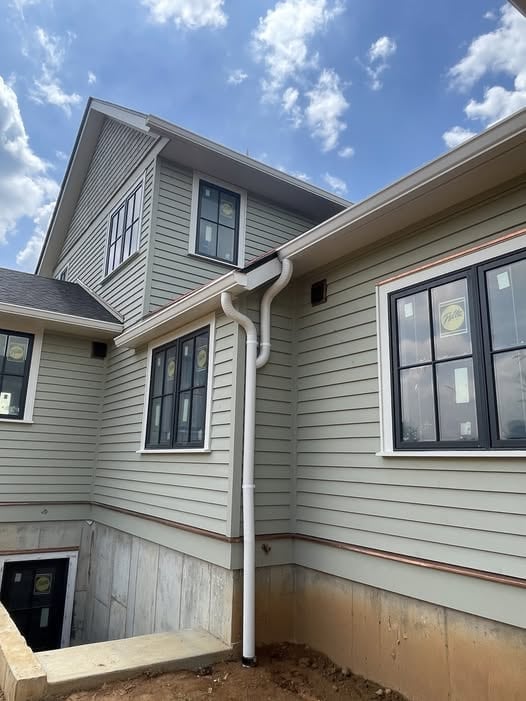
Why drainage matters as much as the gutter
Roof water moves a lot of volume. A 2,000 square foot roof in a one-inch rain event collects roughly 1,250 gallons of water. That water has to go somewhere. The gutter is half the answer; what happens after the downspout is the other half.
We see homes across our service area where the gutters work fine — clean, properly sized, well-maintained — but the foundation is still wet, the basement is damp, the lawn nearest the house is mossy and waterlogged, or the driveway has a permanent dark stain at the bottom of a downspout. The problem isn’t the gutter. The problem is what happens to the water after the gutter.
Splash blocks alone don’t solve real water problems. They redistribute water by maybe two or three feet. On heavy clay soil. Which is most of Central Virginia. A splash block at the base of a downspout creates a steady wet zone that the soil can’t absorb fast enough.
If you are replacing gutters anyway, start with seamless gutter installation and have us price the drainage as a separate line item. If the gutters are fine but the yard or foundation is staying wet, start with a free written drainage estimate.
Solutions we install
Buried downspout discharge
The workhorse solution. A 4-inch SCH 40 PVC pipe buried below frost line, connecting your downspout to a discharge point typically 8 to 20 feet from the foundation. The pipe slopes consistently downhill (we use a laser level on every install) so water actually flows. The discharge point is one of:
- Daylight discharge. Pipe exits at a downhill grade where water runs into a swale or natural drainage area.
- Pop-up emitter. Surface fitting that opens under flow, closes flush when dry. Used when you can’t get pipe slope all the way to daylight.
- Drywell. Buried pit filled with gravel or a structured infiltration unit, sized to hold and slowly disperse roof water into the surrounding soil.
French drain
A different tool for a different problem. French drains collect groundwater (water already in the soil) and redirect it. They’re trenches with perforated pipe and gravel, designed to intercept water moving sideways through the soil. We install French drains when the issue is groundwater. Saturated soil, retaining-wall hydrostatic pressure, hillside seepage. Not roof water.
Sometimes both are needed: a buried downspout discharge for roof water plus a French drain along the uphill foundation wall for groundwater.
Curtain drains and swales
Variants of French drains for specific situations: a curtain drain runs along an uphill property line to intercept water before it reaches your foundation; a swale is a graded surface channel that carries water across your yard to a designated discharge point. Both are useful tools when surface and groundwater are part of the problem.
Coordinated multi-downspout systems
On larger homes and commercial buildings we often connect multiple downspouts into a single buried discharge line, sized for the combined flow. This requires careful pipe sizing, careful slope, and cleanouts at every junction so future maintenance is possible.
Central Virginia drainage patterns we see
Charlottesville and Albemarle hillsides. Water often enters from uphill hardscape, stone walls, or long roof valleys that concentrate flow at one corner. These jobs usually need downspout discharge plus a surface-water plan. Our Albemarle vineyard drainage case study shows why treating every downspout separately can miss the real problem.
Lake Monticello and Lake Anna lots. Waterfront and lake-area homes need roof water moved carefully because yards already hold more moisture and grades can be tight. See our Fluvanna and Louisa pages for lake-area gutter and drainage notes.
Barboursville, Orange, and Madison clay. Heavy clay means the first two feet away from the foundation are usually not enough. A splash block may look neat, but it can keep the same clay pocket wet after every storm. These projects often need longer runs to daylight or pop-up emitters.
Commercial and multi-building properties. Churches, barns, retail buildings, and wineries often have large roof planes draining to too few outlets. We size those systems differently than a single-family house and coordinate them with commercial gutter work.
How we approach drainage
- Look at where water is actually going now. Sometimes during rain, sometimes by reading the lawn (mossy zones, scoured soil, paint failure on siding low to grade).
- Identify the constraints. Where can a buried line go? Where is daylight relative to the house? Are utilities in the way? Is there a septic field?
- Recommend the simplest tool that fixes the problem. A buried discharge to daylight is cheaper and lower-maintenance than a drywell. A drywell is cheaper than a pumped system. Most homes don’t need the most complex solution.
- Quote with specifics. Linear feet of pipe, fittings, discharge type, and any hard-surface restoration (cuts through driveways or sidewalks).
What we check before quoting drainage
- Roof area feeding each downspout. One downspout handling two roof planes needs a different discharge plan than a short porch run.
- Gutter and downspout size. Sometimes the drainage issue starts with undersized 2x3 downspouts or a poorly pitched gutter. We may recommend gutter repair before buried work.
- Fascia and outlet condition. Loose gutters or rotted fascia can make water look like a yard problem when the actual leak starts at the roofline. See fascia and soffit repair.
- Slope to discharge. Buried pipe has to fall. If there is no gravity path, we talk through pop-up emitters, drywells, or a different route.
- Utilities, septic, and property lines. We do not create a new problem by sending roof water toward a neighbor, septic area, or driveway edge.
What we don’t do
We don’t do interior basement waterproofing. That’s a specialty. We’ll refer you to companies we trust.
We don’t pump roof water into a sanitary sewer or septic system. Illegal in most jurisdictions and bad practice everywhere.
We don’t install drainage that violates property-line setbacks or directs water onto neighboring property. Both are recipe for legal headaches.
Where we work
All nine counties: Charlottesville, Albemarle, Barboursville, Orange, Madison, Greene, Fluvanna, Louisa, and Culpeper.
Related work
- Seamless gutter installation. Frequently combined with drainage work.
- Gutter cleaning. Sometimes the cleaning fixes the problem; sometimes it reveals the drainage issue.
- Gutter guards. Guards reduce gutter blockages, but they do not replace a real discharge plan.
- Commercial gutters. Commercial work almost always includes drainage planning.
Ready to stop water from collecting beside the house? Request a free estimate and we will trace the water from roof edge to final discharge point.