
What we mean by “seamless”
Seamless aluminum gutters are extruded on site from a continuous coil of aluminum, custom-cut to the exact length of your roof line. Unlike sectional gutters (which come in pre-cut 10-foot pieces assembled with caulked seams), seamless systems have only end caps and corner miters as joinery. Every linear foot in between is one continuous piece of metal.
We bring the gutter machine to your property, feed in the coil, and the machine extrudes the gutter as one piece. No factory seams, no field seams in the runs, no future leak points along the straight sections.
For a homeowner searching for gutter installation in Charlottesville or Central Virginia, this is the main difference that matters: the gutter is made for your roof line, not pulled from a shelf in sections and forced to fit. On older Charlottesville homes with short returns and tight alleys, that keeps the visible runs cleaner. On newer Albemarle, Barboursville, and Orange homes with long straight roof edges, it removes the mid-run seams that usually start leaking first.
What goes wrong with cheap gutter installs
Five things kill gutter systems early. We see them on the tear-offs every week:
- .027 gauge aluminum. The most common gauge sold by big-box stores and cheap installers. It dents from a falling acorn and sags under wet leaves. We use .032. About 20% thicker, dramatically stiffer.
- Spike-and-ferrule hangers driven through the front face of the gutter into the fascia. They work loose over five to seven years as the wood shrinks and the aluminum cycles in temperature. Hidden hangers, anchored into the rafter tail, last decades.
- Hangers spaced 32-36 inches apart. The minimum allowed but not the right answer for ice and snow zones. We hang at 24 inches as our default, 18 inches on metal-roof and ridge-top homes.
- Undersized downspouts. Standard 2x3 downspouts plug instantly when oak acorns or sweet gum balls hit. We default to 3x4 on most jobs, which is roughly 40% more cross-section.
- No drip edge integration. Water sneaks behind the gutter and rots the fascia. We integrate gutter apron / drip edge flashing on every install where it’s missing.
Our standard install spec
For a typical Central VA home, here’s what we install unless you’ve asked for something else:
- Gutter: 5-inch or 6-inch K-style, .032-gauge aluminum, color matched.
- Hangers: Hidden hangers screwed into the rafter tail every 24 inches; 18 inches on snow-load homes.
- Corners: Hand-mitered and riveted, then sealed with manufacturer-approved sealant.
- End caps: Riveted and sealed.
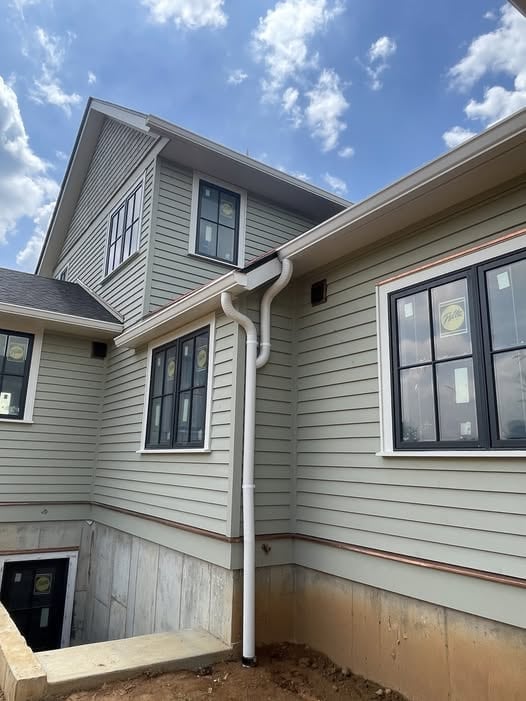
- Downspouts: 3x4, with elbows and a kick-out at the bottom; minimum two per typical home, more on larger or steeper roofs.
- Drip edge / gutter apron: Installed if missing, ensuring water enters the gutter rather than wicking behind the fascia.
5-inch vs 6-inch gutters
The right size depends on roof area, pitch, valleys, and tree cover. A simple one-story ranch with short roof runs may be fine with 5-inch K-style. A steep two-story home, a house with long valleys, or a roof that dumps a lot of water into one corner usually needs 6-inch gutters and more downspout capacity.
In Charlottesville, the deciding factor is often roof complexity and tree canopy. Belmont, Rugby, and North Downtown homes tend to have older rooflines and more debris. In Albemarle County, newer subdivisions like Forest Lakes and Hollymead often have longer straight runs where the builder-grade system was undersized from day one. In Madison and Culpeper, metal roofs and heavier snow loads push us toward tighter hanger spacing and snow-guard planning.
We do not sell 6-inch gutters as an automatic upsell. We measure the roof and explain why the size is or is not needed.
The measurement and quote process
We come to your home, walk every roof edge, measure runs and corners, count downspouts, and look at the fascia underneath. The fascia inspection matters. If the wood behind your existing gutter is rotted, that has to come out and be replaced before we hang new metal. We give you a written quote on site or within 24 hours that breaks out gutter linear feet, downspouts, accessories, and fascia repair separately.
No high-pressure sales, no “today only” pricing. The price we quote on Tuesday is the same price the following Tuesday.
If the existing system is close enough to save, we say that too. Our repair vs replacement checklist explains the line we use on estimates: metal gauge, hanger type, pitch, fascia condition, downspout sizing, and whether the leak is one bad part or the whole system failing together.
What we look for before replacing gutters
A good gutter install starts before the new metal comes off the machine. On every estimate we check:
- Fascia condition. Soft or rotten wood has to be repaired before new gutters go up. See fascia and soffit repair for how we handle that work.
- Downspout placement. Water needs a clean path away from the foundation. When splash blocks are not enough, we quote drainage solutions with the install.
- Tree load. Heavy oak, tulip poplar, pine, or sweet gum changes the recommendation. Some homes should add gutter guards during install; some are better served by scheduled gutter cleaning.
- Roof material. Metal roofs need a different snow and hanger conversation than asphalt shingles.
- Existing warranty or repair value. If the current gutters are good enough to repair, we tell you before quoting full replacement.
That inspection is why our quote takes a little longer than a phone estimate. It also keeps surprises off the install day.
Snow guards for metal-roof homes
If your home has a standing-seam, ribbed-metal, or corrugated-metal roof, the install changes meaningfully. Slick metal sheds snow in heavy sliding slabs every winter, and a slab catching the front of an unprotected gutter can rip the entire run off the fascia in one event. We see this every February on Madison, Albemarle, and Culpeper farmhouses where a previous installer skipped the snow-guard conversation.
Our standard metal-roof install includes:
- Snow guards in staggered rows mounted to the roof above the gutter line. The pattern depends on roof pitch and slab length; we typically run two to three offset rows so any sliding slab gets broken up into smaller pieces before it reaches the gutter edge.
- Hanger spacing tightened from our usual 24 inches to 18 inches, with extra fasteners on the windward side for ridge-top properties.
- Reinforced gutter bracketing at known slide zones (typically the downhill-facing slope) so the gutter has additional support where snow will pile up.
Snow guards are inexpensive next to the cost of replacing torn-off gutters and damaged fascia mid-winter. We won’t quote a standing-seam metal-roof install without including them.
Where we install
We install seamless gutters across all nine Central Virginia counties we serve: Charlottesville, Barboursville, Orange, Madison, Greene, Fluvanna, Louisa, Albemarle, and Culpeper County. Same pricing, same spec, same crew across the entire service area.
One example: our Charlottesville tulip poplar case study shows what happens when old gutters, failed foam inserts, fascia rot, and guard replacement all show up on the same job. It is exactly the kind of work where measuring, fascia inspection, and product choice matter.
Common companion services
Most installs include or trigger one of these:
- Gutter guards. About two-thirds of our install customers add micro-mesh or aluminum guards from Leaf Solution.
- Fascia and soffit. Wood replacement before new gutters go up.
- Drainage solutions. Buried downspout discharge to keep water away from foundations.
- Half-round gutters. For historic homes and architect-designed properties where K-style is wrong.
- Repair vs replacement. For homeowners who are not sure whether a repair is still worth doing.
- Verified review history. Read the independent HomeAdvisor record before you schedule.
Ready to price the work? Start with a free written estimate. We will walk the roofline, measure the runs, inspect the fascia, and give you a quote that separates gutter work from any optional add-ons.